
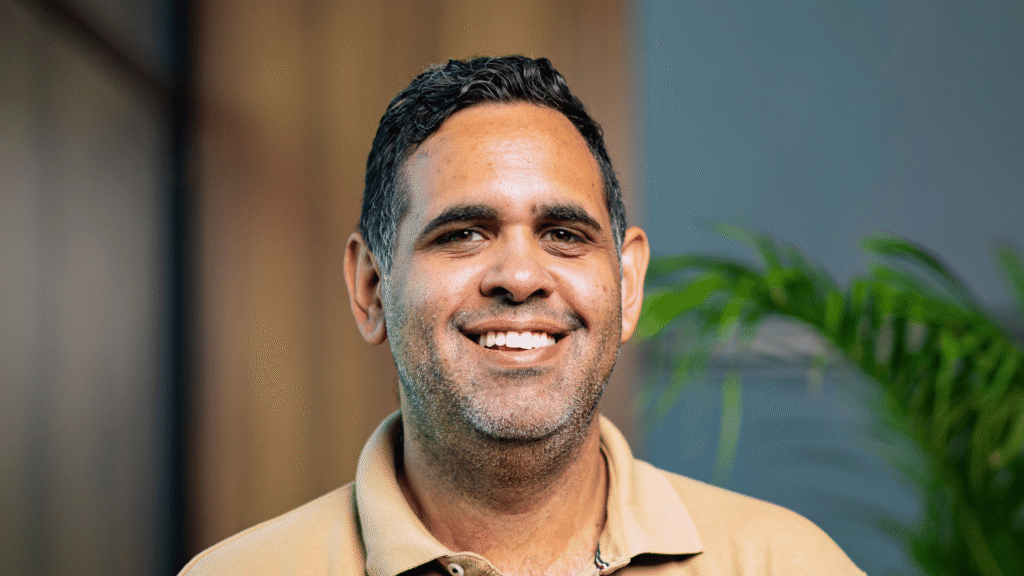
AIDA Student Director, Gari Watson, grew up in the Brisbane–Murri Community and is currently studying medicine at the University of Queensland. The Gurang Gurang, Biri Gubba, and Gangulu man is now in his fourth year of medical school. He brings with him many years of experience working as a dentist and a strong commitment to improving health outcomes for Aboriginal and Torres Strait Islander Communities.
Before beginning his medical training, Gari worked in dentistry for many years. Through that work in Community, he began to feel called toward a broader role in healthcare where he could support patients and build long-term relationships.
“Through that role of working with people and working with mob in the Community, I was inspired to want to do more for my mob,” he says.
“I chose to pursue medicine so that I can have a broader scope of practice and build that relationship with mob and make really meaningful changes in a holistic way.”
Returning to study later in life
“As a more mature student it had its challenges,” he says. “There are days where you think you can’t do that.”
Alongside the academic demands of medical training, he also had to adjust to studying in an environment where many students were much younger.
“I think the other thing is the struggles of trying to fit in as a mature student,” he shares.
Despite those challenges, Gari remained determined to continue.
“I think ultimately if your hearts in it and you’ve got the passion; you can achieve it.”
Finding strength through challenges
Watson also speaks openly about experiencing racism during his time studying medicine.
“The amount of unsafe environments that I experienced going through uni and the overt racism that I’d faced over the years through studying was quite a difficult barrier for me to overcome,” he recalls.
Support networks and resilience helped him continue through those experiences.
“But I think looking through it, I can take a lot of resilience with that and have the support around me to continue pursuing and overcoming that battle.”
Seeing mob in the healthcare system
Throughout his placements, Gari says one of the most meaningful moments has been connecting with Aboriginal and Torres Strait Islander patients.
“It’s been quite a proud moment seeing mob and them seeing your face as well,” he shares.
For Gari, representation in healthcare can have a powerful impact particularly in a system that hasn’t always felt safe for Aboriginal and Torres Strait Islander people.
“You’re essentially working in a Western model where a lot of non-Indigenous people don’t understand how culture is so important for our mob as well,” he says.
“It’s such a beautiful thing for mob to feel safe and supported and know that there’s mob around them.”
Even small moments of connection can make a difference.
“You can’t do much at that time sometimes by just having that face around and understanding the journey is a big part of making sure mob feel culturally safe when going through the health system,” he says.
Building the next generation of doctors
Gari believes the growing number of Aboriginal and Torres Strait Islander doctors is essential for improving health outcomes.
“It’s very important that we continue to support Aboriginal and Torres Strait Islander doctors and ensure we continue to build that workforce,” he says.
“Without our mob working in the health sector, how are we going to make positive changes?
He shares: “For many years we’ve had the wrong people, people that don’t understand our own mob try to make decisions and we know that it’s still not working.”
For Gari, strengthening the workforce means supporting more Aboriginal and Torres Strait Islander students to pursue careers in medicine.
“Build that frontline workforce and make real impact for our mob to have better health outcomes,” he says.
A message for future doctors
Gari says seeing more Aboriginal and Torres Strait Islander medical students coming through gives him hope for the future.
“I’m very proud to see how many First Nations medical students are coming through and meeting them along my journey,” he says.
Their strength and resilience continue to inspire him.
“It gives me a lot of strength to know that I’m not alone and that we’re doing it together.”
For those considering a career in medicine, Gari offers a simple message.
“If you’re considering studying medicine, just do it,” he says. “We need so much more mob working in medicine.”
“There are so many opportunities and so many disciplines where you can make real change.”