
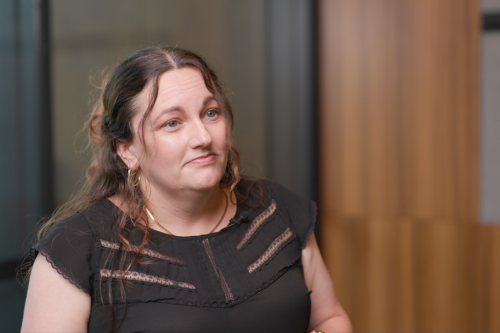
Wonnarua woman Dr Leila Usher is an obstetrician-gynaecologist working on Awabakal and Worimi Country in Newcastle, New South Wales. Her career has been shaped by a commitment to improving care for Aboriginal and Torres Strait Islander women and families.
Her pathway into medicine began long before medical school.
“I moved out of home when I was 15 and followed mob wherever they went,” she recalls.
She later completed high school and enrolled in a bridging program at the University of Newcastle.
At the time, medicine had not been part of her plans.
“I thought maybe I’d be a nurse or do something like that,” she shares.
Friends in the program encouraged her to apply for medicine, something she had never imagined for herself.
“They said, come and interview for medicine.”
She applied, was accepted into the program and began medical school.
“I got in and I just haven’t left.”
Carving her own pathway
Dr Usher became the first person in her family to finish high school and attend university.
While studying medicine, she was also raising a young family.
“I actually had a baby in first year of medicine,” she says. “And then I stuck around anyway and had another baby.”
She welcomed another child during her junior doctor training.
Many expected she might choose a less demanding career pathway, but Dr Usher discovered a passion for obstetrics and gynaecology.
“To be with women, to work with women from adolescence to menopause is a joy,” she says.
“And to birth babies is an even greater feeling.”
Changing the system from within
For Dr Usher, becoming a doctor has always been about improving the healthcare system for Aboriginal and Torres Strait Islander people.
“The only way to do that is by us being in that system and changing it from the inside,” she says.
She now works alongside a growing number of Aboriginal doctors entering obstetrics and gynaecology.
“I now have six other junior doctors trying to get through who are all mob, who are all part of our obstetrics and gynaecology family.”
Seeing that growth is shifting the culture of the department.
“It’s wonderful to see how much it’s actually changing the department as a whole and how they think,” she shares.
Improving care for Aboriginal and Torres Strait Islander women
During her training, Dr Usher helped establish an outreach mothers and babies program at a local Aboriginal Medical Service.
The program aimed to strengthen connections between hospital maternity services and Community.
“Just having someone out in the space and allowing them to see that the hospital is theirs,” she says.
The impact was immediate.
“The DNA [Did Not Attend] rate went from 30 per cent down to 15 per cent.”
For Dr Usher, the work is about ensuring Aboriginal and Torres Strait Islander families feel welcome and safe in healthcare settings.
“It’s our Country, it’s our land, it’s our hospital,” she shares. “We shouldn’t feel like it’s a place that’s not for us.”
Learning from lived experience
Dr Usher’s own experiences navigating the health system as a young mother continue to shape the way she practices medicine.
“I was a 19-year-old single mum, so that automatically put me in the naughty corner,” she says.
She remembers hearing comments that reflected broader issues in healthcare.
“The horrible things I heard… I didn’t feel like I could say something back to at the time.”
Those experiences now inform her commitment to culturally safe care.
“Changing things from the inside out is the only way that’s going to fix them.”
Culture at the centre of care
For Dr Usher, culture underpins every part of her work.
“Culture underpins everything that I do as a woman,” she says. “I’m a mother first, then a doctor.”
She believes culturally informed care benefits all patients.
“If you can get care right for First Nations people, everyone will benefit.”
Family and connection
For Dr Usher, organisations like AIDA play an important role in supporting Aboriginal and Torres Strait Islander doctors throughout their careers.
“It’s not really being a member of AIDA,” she says. “It’s being family.”
Gathering through AIDA events provides connection and support for doctors working across the country.
“Coming here every year is like a trip home.”