Peter is a proud Wakka Wakka and Wuli Wuli man from Central Queensland. With over 25 years’ experience in health and higher education, he is guided by a commitment to cultural integrity and strategic vision. His extensive background drives the impactful work throughout his career.
Peter has worked in primary care and the university sector to drive change and develop programs that improve health and education outcomes for Aboriginal and Torres Strait Islander communities. He has focused on strengthening health systems by co-designing services and programs that centre Aboriginal and Torres Strait Islander voices.
Before joining AIDA, Peter broadened his executive experience in higher education and health. He was Director of Indigenous Health Education, Medicine and Health, and Indigenous Research Lead at the National Alcohol and Drug Research Centre at UNSW, and CEO of the Townsville Aboriginal and Islander Health Service. Peter is also an Adjunct Associate Professor in the College of Medicine and Dentistry at James Cook University.
Peter’s influence extends beyond these roles. He also serves on several boards, including a ministerial appointment as a Board Director of the Cancer Institute of NSW. He contributes to strong governance and sector reform through the Optometry Council of Australia and New Zealand and the Indigenous Wellbeing Centre Limited.
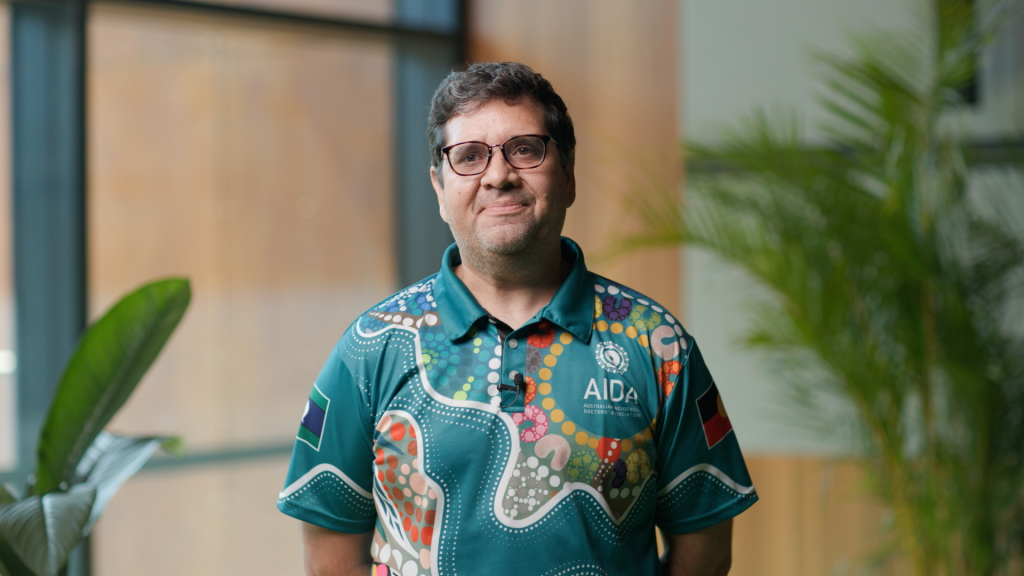
These extensive experiences inform his leadership as AIDA moves forward with its 2026 to 2030 Strategic Plan. Peter’s leadership and cultural grounding show the organisation’s commitment to self-determination, cultural governance, and making a real difference for Aboriginal and Torres Strait Islander doctors, medical students, and communities.
We asked Peter about his journey, his values, and his vision for AIDA’s future.
Tell us about your professional journey and what led you to AIDA?
I left school before finishing Year 12, and for a while, I had no clear sense of where I was headed. My mother, who was an Aboriginal Health Worker, encouraged me to consider a career in health. She pushed me to apply for a traineeship at Townsville Hospital as a Pathology Assistant, and later, I worked as an Aboriginal Health Worker. That early exposure to the health system, and to caring for the mob, set the direction for everything that followed.
Over the past 25 years, my career has largely intersected with health and higher education. I have been fortunate to have worked across Queensland and New South Wales, working alongside Aboriginal and Torres Strait Islander communities and stakeholders to strengthen service delivery, shape education and training programs, and contribute to research that translates into practical improvements. Those roles reinforced for me that good governance and good outcomes are inseparable: culturally informed, evidence-based decisions are strongest when communities have a genuine voice in design, implementation, and accountability.
More recently, I stepped into the national spotlight when I led the COVID‑19 public health response with 44 Aboriginal Community Controlled Health Services in New South Wales and contributed to national advisory groups during the pandemic. That period underscored for me the importance of trusted partnerships, clear decision‑making structures, and culturally safe approaches to communication and care for mob—especially when systems are under pressure.
This intersection of education and health leadership is central to my current role. I combine my passion for both to drive change in medical training and highlight AIDA’s belief that Cultural Safety is Clinical Safety. I am committed to keeping this at the heart of how the profession grows and is supported.
All these experiences have shaped my commitment to culturally informed, evidence-based and community-driven health care, and continue to guide my vision for the future.
What values are central to leading an organisation like AIDA?
The values central to leading an organisation like AIDA begin with a clear understanding of why the organisation exists, and deep respect for the self-determination of its founding members, those who have invested sustained effort to drive system change and to create the conditions for AIDA’s work. Leadership in this context is not simply managerial; it is custodial. It requires protecting the organisation’s purpose, stewarding its legitimacy, and ensuring it remains accountable to the members and communities it represents.
The values I uphold as central are cultural integrity and cultural sovereignty. For Aboriginal and Torres Strait Islander peoples, these are not symbolic commitments; they are governing principles that shape how decisions are made, whose voices are centred, and what accountability looks like. Cultural integrity requires that the organisation’s conduct, partnerships, advocacy, and internal practices align with community-held knowledge, cultural authority, and ethical responsibilities. Cultural sovereignty affirms that Aboriginal and Torres Strait Islander peoples retain the right to define priorities, determine solutions, and lead the narratives that affect our health and wellbeing.
These values have guided my work on national advisory committees and parliamentary inquiries focused on rural health access, mental health, suicide prevention, and COVID-19. Cultural integrity has always been essential to ensuring systems and structures respond to community priorities.
How will you strengthen AIDA’s support for Aboriginal and Torres Strait Islander members?
I will strengthen AIDA’s support for Aboriginal and Torres Strait Islander members by being consistently visible and present, and by demonstrating in practical ways that members are valued and that their voices carry real influence. As a member organisation, AIDA must remain outward-facing and accountable to its membership, engaging regularly so that members’ perspectives are not simply heard but embedded in how the organisation sets priorities, makes decisions, and evaluates its impact.
This requires more than consultation. It requires representation and governance settings that enable Aboriginal and Torres Strait Islander members to see themselves reflected across AIDA’s work, including in leadership pathways, advisory structures, and decision-making processes. When members’ priorities, concerns, and ways of doing business shape the organisation, AIDA strengthens its legitimacy, improves cultural safety, and delivers outcomes that are aligned with community expectations and professional realities.
Across my academic and professional career, I have mentored Aboriginal and Torres Strait Islander researchers, medical students, and early-career professionals. Supporting the next generation has been a consistent focus of my work, and it will continue to guide how I contribute to strengthening AIDA’s support for members and staff through culturally safe leadership, structured capability-building, and opportunities that translate into long-term professional and organisational strength.
What is your vision for AIDA over the next few years?
My vision is for a system change that builds on the work of our founding members to transform the medical training pipeline in ways that genuinely recognise cultural fellowship, connection, and belonging. By developing a culturally safe and supportive training ecosystem, we can create the conditions for sustained growth in the number and strength of Aboriginal and Torres Strait Islander doctors and specialists, and for their progression into leadership across the profession.
AIDA plays a critical role in supporting medical colleges and universities in building the cultural capability required to meet the needs of Aboriginal and Torres Strait Islander medical students, trainees, and fellows. This cannot be limited to statements of intent; it must be demonstrated through concrete actions, clear accountability, and measurable outcomes that endure over time. In an Australian health system shaped by governance obligations, equity commitments and expectations of public value, cultural safety must be embedded as a core capability rather than treated as an optional add-on.
We must also continue to advocate for improved health outcomes for Aboriginal and Torres Strait Islander communities and strengthen our influence through genuine partnership with key stakeholders across the sector. As a researcher, I see evidence as foundational to this work: we need to design and evaluate programs and services that are informed by what works, aligned to a clear theory of change, and capable of demonstrating impact for trainees, institutions, and communities.
How will you build on AIDA’s relationships with colleges, governments, and universities?
Building on AIDA’s relationships with colleges, governments, and universities requires deliberate engagement grounded in shared responsibility for a culturally responsive medical training pipeline. The priority is to understand, with precision, how each partner currently defines and delivers cultural safety and cultural capability, and then to align expectations around what good practice looks like in policy, curriculum, training environments, and assessment. AIDA cannot realise its full purpose without these institutions because they control key levers of medical education, accreditation, funding, workforce planning and professional standards.
My role would be to ensure our dialogue with these partners is framed by a clear willingness to change, strengthened by accountability, and focused on building an Aboriginal and Torres Strait Islander medical workforce that is supported from entry through to fellowship and specialist leadership. This means moving beyond goodwill to practical commitments that can be tracked over time, including how cultural safety is governed, resourced and embedded across training settings, and how Aboriginal and Torres Strait Islander trainees are supported and protected from cultural load and institutional harm.
In previous roles, I have worked with universities to Indigenise medical curricula and have partnered with Primary Health Networks to co-design local models of care across Queensland. Those experiences provide a strong foundation for advancing AIDA’s work with colleges, governments, and universities, particularly by strengthening cultural capability across the medical education and training continuum and by supporting partners in translating policy intent into consistent practice and measurable outcomes.
How will you ensure decisions and strategy are guided by First Nations’ knowledges and voices?
Ensuring decisions and strategy are guided by First Nations knowledges and voices starts with recognising that Aboriginal and Torres Strait Islander authority must sit at the centre of how AIDA governs, leads, and operates. The voices of Community, members, the Board, and staff are not optional inputs; they are the primary source of legitimacy for our direction and the standard against which our decisions should be tested. For this reason, AIDA will continue to develop and implement cultural governance so that our ways of knowing, being and doing are embedded in both strategic priorities and everyday organisational practice.
This requires a close partnership with the Board to strengthen cultural governance across the organisation. Strong governance frameworks grounded in Aboriginal and Torres Strait Islander knowledge systems will shape how we set strategy, allocate resources, manage risk, and evaluate impact, ensuring cultural safety and accountability are not peripheral but integral to corporate decision-making. In practical terms, cultural governance must influence what we measure, how we report, and how we hold ourselves accountable to members and the community.
Most importantly, we must lead through an Aboriginal and Torres Strait Islander leadership lens. That means privileging Community and members’ voices, respecting cultural protocols, and embedding cultural practices into how we do business, including how we consult, communicate, partner, and represent our members. As CEO, it is my responsibility to model this leadership consistently across the organisation, ensuring that cultural governance is lived in practice and that First Nations knowledges and voices remain the guiding authority for AIDA’s strategy and decisions.
What is your message to AIDA members as the new AIDA CEO?
AIDA is entering a period of growth and change under our new strategic plan. We will build on the strong foundations laid by those who came before us and continue strengthening our collective resolve to grow the next generation of Aboriginal and Torres Strait Islander medical students, doctors, and specialists across the full health continuum.
My message to members is one of hope and shared purpose. I step into this role committed to open, transparent, and responsive leadership, guided by the voices of our members. AIDA exists because of its members, and our legitimacy comes from staying connected to your priorities, experiences, and aspirations.
I bring longstanding relationships with Aboriginal and Torres Strait Islander Communities across Queensland and New South Wales, and I will remain focused on ensuring AIDA’s work is grounded in cultural integrity, evidence, and Community-defined priorities. That means strengthening cultural governance, building culturally safe training pathways, and advocating for the conditions that allow our people not only to enter medicine, but to thrive, lead and shape the profession.
AIDA has a critical role in Closing the Gap and in ensuring Aboriginal and Torres Strait Islander doctors and medical students are central to shaping Australia’s health system and its future. I am committed to working in genuine partnership with our strategic stakeholders, colleges, universities, governments, and health services, so that our influence is tangible, our impact is measurable, and our work remains accountable to Aboriginal and Torres Strait Islander communities.